I find it pertinent to express myself on this Monday morning at 2am after watching the movie “Digger,” which depicts a play of a wealthy businessman whose oil business causes various global environmental crises, and ultimately destabilizes world order.
For those of you that haven’t watched the movie yet, I highly recommend that you click off of this blog and GO WATCH IT! There are movies you like and movies you hate, but this movie will unsettle you. It’ll express an element of truth that is bluntly refreshing in a world that’s currently lacking clarity.
WARNING: SPOILERS AHEAD.
Digger’s pet is an absurdly old and rather zombified cat named Maggie that should’ve died years ago, but is tied to its last thread of life via a boatload of meds. If there is any character in this movie that Digger holds the most affinity to, it is Maggie. In Maggie’s last moment before her death, she loathingly sinks one of her only teeth into Digger’s pinky, popping his vein and requiring him to grotesquely stitch his finger up.
When Digger recounts this situation to Dr. Ganesh, his Head of Environmental Safety, Dr. Ganesh points out how perhaps the cat never loved Digger. On the contrary, the cat has hated Digger since time immemorial but was “clinging onto him for dear life.”
Maggie is perhaps a symbol of the ordinary man, who clings onto those in power for his dear life, a symbol of liberty and livelihood. As this man sees how the democracy he knows and loves is steadily unravelled, he grows to hate this system, but nonetheless adheres to it because any system of governance is better than anarchy, a freedom equivalent to death.
In another scene, when Digger is delivering a speech to the European Union, he screams out buzzwords to the audience of legislators, to which they either cheer or disapprove of.
“Oil drilling!”
BOO!
“Solar energy!”
YAY!
“Nuclear energy!”
YAY!
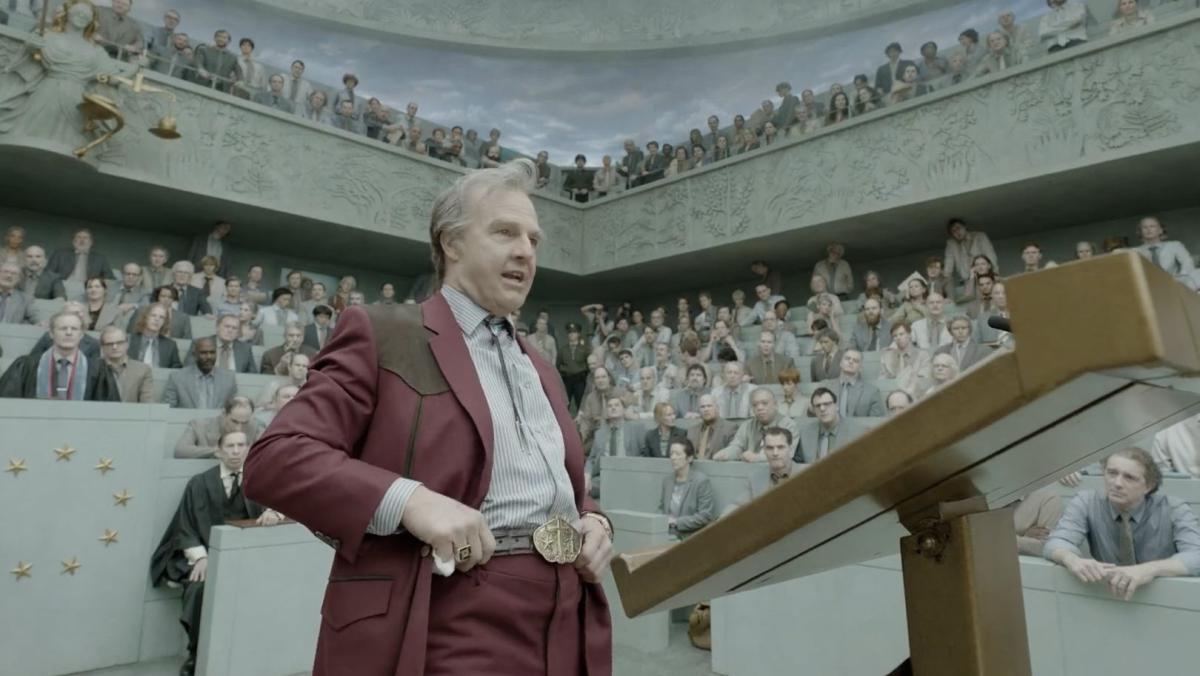
He then describes how challenging and unrealistic these new systems would be to adopt and how the reality of the oil situation is much more complex than a few buzzwords to cheer for. There are many aspects of this scene to dissect, but generally it did prompt the questions:
Is modern politics too shallow and unrepresentative of the world's intricacy?
Has noble statecraft descended into the primitive cheering and booing of buzzwords to give us a false sense of hope that we’re taking action on issues we ultimately don’t fully comprehend?
To give an example, why are we so infuriated by the privacy risks of Flock cameras when we remain unperturbed by the omnipresent recording and surveillance from our smart phones? After all, perfection leaves no room for contradiction.

I do not inherently dismiss the validity of any political action. However, it's almost as if we care about feeling as if were doing something more than we care about substantively approaching an issue. Maybe we engage in politics in the current way we do–in this theatrical dance of sensual gratification–to escape the fear of abandoning hope and of giving up.
There is a lot of complaining and a lot of inadequate action in this world. However, what is the true path forward?